
The agave glut: how long, what growers can do, and who kept the savings
The short answer
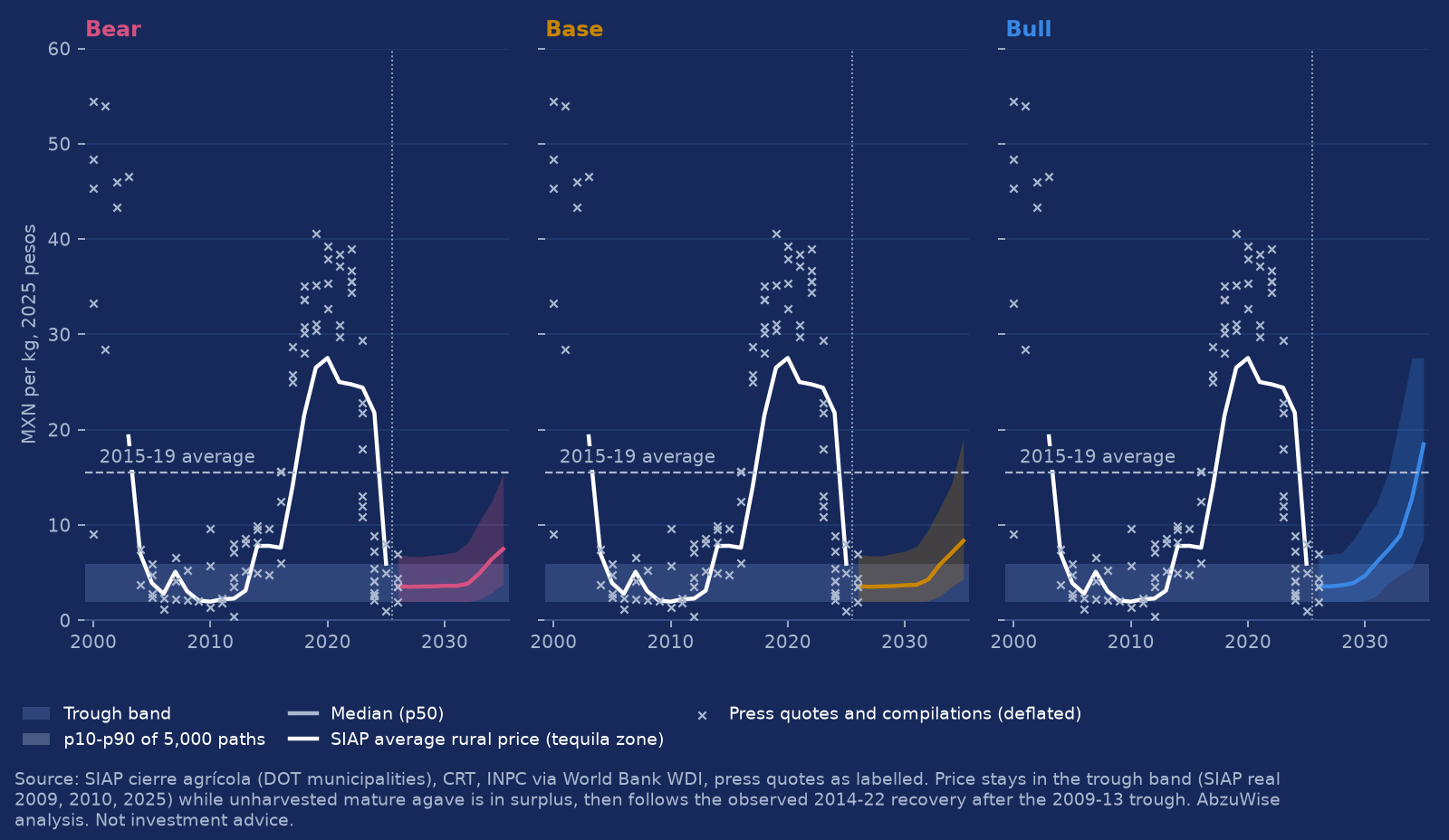
- Agave prices in the tequila zone are back in a trough: 5.9 pesos per kilo in 2025 on the official annual average, against 27.5 at the 2020 peak (both in real 2025 pesos). That average is smoothed: a press quote published in 2024 put the late-2022 spot peak around 34 pesos (nominal), and dated spot quotes were mostly under 5 by 2024.
- How long the glut lasts depends above all on which count of standing agave is right. On the government’s survey of planted area, corrected for two recording problems, the surplus is used up between 2031 and 2035 in our base case. On the plantation registry of the Tequila Regulatory Council, more than twice as large (the Council gave the figure to EFE in July 2026; no Council document publishes it), it lasts to 2035 or beyond.
- In the base and bear cases, holding agave to a fixed year loses against selling now in every case we tested; it can pay only in the bull case.
- The public evidence suggests most of the agave savings had not reached U.S. shelf prices by 2025; with no tequila price index, this cannot be measured directly.
1. How long will prices stay low?
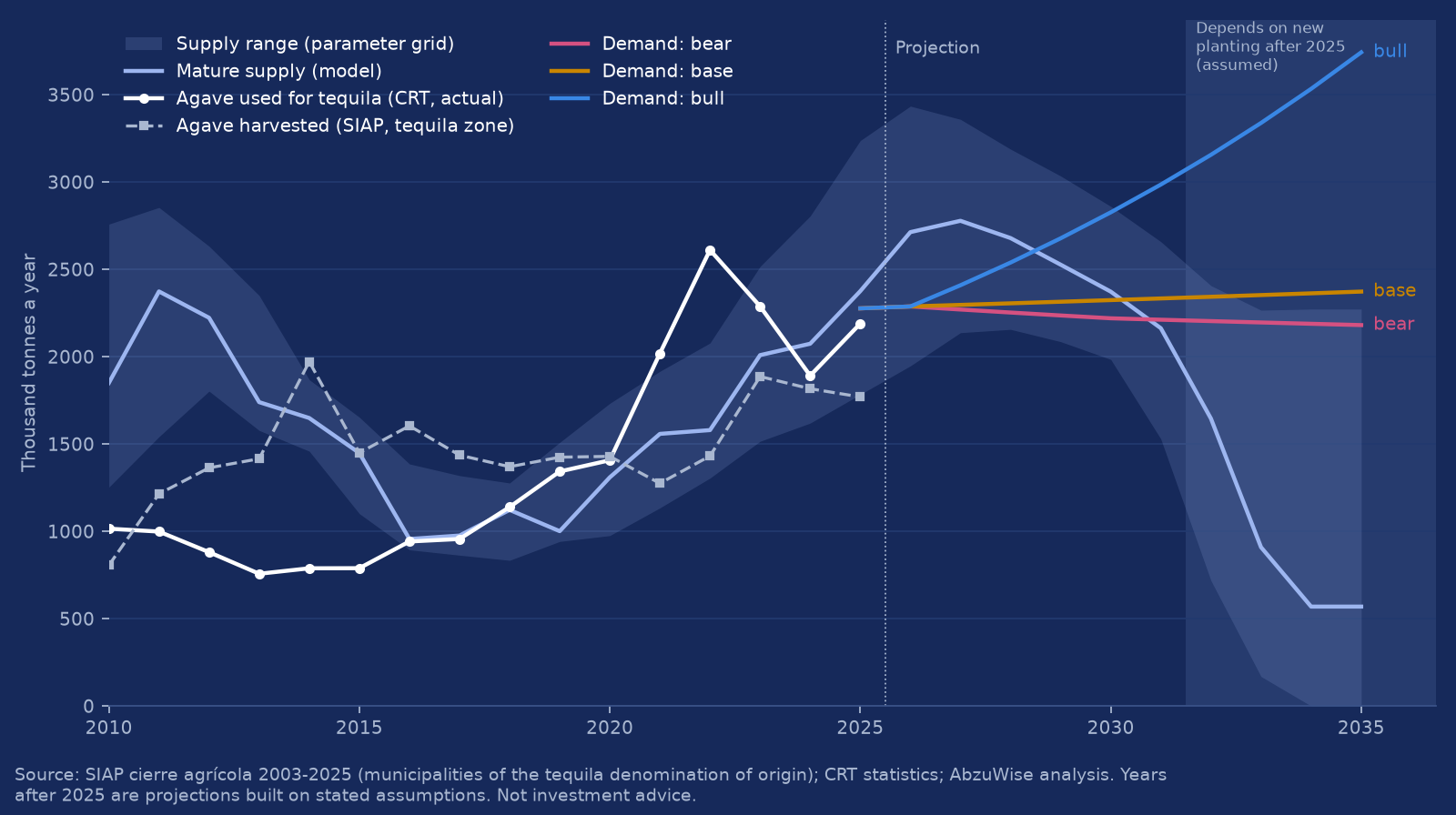
Supply comes from plants set out six to eight years earlier. We follow every planting year through to harvest in the 181 tequila-zone municipalities and set it against the agave tequila uses, split into U.S. exports, other exports and Mexico.
- The glut is mostly a stock, not a flow. In 2026 mature supply is about 1.19 times what tequila needs (range 0.82 to 1.56, so the low end is a deficit), a surplus of about 0.4 million tonnes (from a deficit of 0.4 to a surplus of 1.2). The yearly surplus lasts only about 5 years. What keeps prices down is the unharvested agave already in the fields.
- When the surplus is used up (tenth to ninetieth percentile of simulated paths): base 2031 to 2035; bull, U.S. recovery and faster growth elsewhere, 2029 to 2032; bear, a shrinking U.S., 2032 to after 2035. Whether surplus agave keeps in the field or rots at 15% a year changes these by about a year.
- Which stock count is right is the biggest open question. The survey’s standing area equals about 8 years of tequila’s 2025 agave use. The Council’s registry equals 19 years on its area and 27 years on its plant count. Read at registry scale, the surplus lasts to 2035 or beyond in every scenario.
- Recovery. After the last trough (2009-13), price took 5 years after the surplus cleared to climb back to its 2015-19 average of 15.48 pesos (the 2014-22 recovery). Using that one observed recovery, price is not back at that average before 2035 in most base-case paths (tenth to ninetieth percentile: 2035 to after 2035); in the bull case the range is 2033 to after 2035 (tenth to ninetieth percentile). Full recovery to the 2015-19 average is not expected before the mid-2030s in the base case. Until then the model holds price around the band of past troughs (1.96 to 5.94 pesos), with swings from one year to the next that can take it above.
How we built this. The piece is built only from the public sources listed under Sources. The price paths are driven by the supply balance, not by a regression forecast.
The official average lags the market. On the way down the official average lagged the market by one to two years: in 2024 it still read 21.8 pesos while dated press quotes had a median of 4.2.
Two corrections to the official data. The survey’s 2025 file duplicates Guanajuato’s agave as irrigated rows; we drop them. And a 2023 recount in the La Barca district is real area that was missing from earlier years; without it the recorded stock could not have supplied the harvests of 2015-21.
2. What can a grower do with surplus agave?
Values in pesos per tonne of mature agave (2025 pesos; the 2026 press prices are nominal):
| Option | Low | Mid | High | What it is |
|---|---|---|---|---|
| Spot sale to intermediaries | 500 | 1,650 | 3,000 | 2026 press quotes; the buyer harvests |
| Average farm-gate price in the trough | 1,956 | 3,947 | 5,939 | official average of all sales |
| Contract sale, net of harvest and haul | 3,826 | 4,998 | 7,320 | press-reported prices under a Tequila Regulatory Council program; limited places |
| Mezcal makers (proxy) | 2,595 | 2,855 | 3,114 | espadín price; only inside the mezcal origin zone |
Syrup, inulin and bioethanol are often named as outlets. We can only value the end product per tonne of agave, before any processing cost: syrup 8,580 to 19,468, inulin 13,274 to 15,929, ethanol 574 to 822. These are not prices paid to growers: no buyer publishes one, and the processing plants that exist are small next to the surplus.
Fiber. Leaves cut at harvest can be sold as silage for 0 to 2,150 pesos per tonne of piña (mid 1,720), on top of the sale of the piña; this has only been tried at pilot scale. Bagasse, the fiber left after distilling, stays with the distillery.
Hold or sell now? Harvest and haul cost about 2,002 pesos a tonne. We test 27 cases (plant age, field loss, discount rate) under two readings of how much price swings from year to year: the survey’s own swings in the last trough, which we use as the main reading, and the much wider spread of 2025-26 press quotes, which mixes buyers and regions and overstates swings over time. Gains and losses are pesos per tonne compared with selling now.
| Scenario | Holding to a fixed year | Selling in a good year, survey swings: cases, best gain | Same, press spread |
|---|---|---|---|
| Base | loses 287 to 853 | 10 of 27 cases, up to 431 | 23 of 27 cases, up to 1,166 |
| Bear | loses 307 to 867 | 6 of 27 cases, up to 313 | 21 of 27 cases, up to 989 |
| Bull | from a loss of 809 to a gain of 1,124 | 21 of 27 cases, up to 1,712 | 24 of 27 cases, up to 2,455 |
The value of waiting comes entirely from the assumed price swings, and from recovery arriving inside a plantation’s field life, which happens mainly in the bull case.
3. Did cheaper agave reach the shelf?
We checked 16 U.S. bottles, confirming from their labels which are 100% agave (13) and which are mixto (3).
- At 2022-23 agave prices (the cost peak for bottles made then) the agave in a $19.99 mixto bottle cost about $2.00; at 2025 prices $0.45. In a 100% agave bottle ($24.99 to $59.99) it went from $4.44 to $1.04. The savings come to 6% to 14% of the shelf price.
- If competitive firms passed it on through the distribution chain’s markups, 100% agave bottles would be 10% to 23% cheaper; a single seller facing straight-line demand would pass on half, 5% to 12%.
- The shelf effect cannot be attributed with CPI data: the U.S. index has no tequila item. The index for spirits bought for home use rose 3.8% from 2022 to January-September 2026, a fall of 8.6% only after inflation. Becle’s gross margin went from 50.7% in 2023 to 56.0% in 2025, which Becle attributed mainly to lower agave costs, along with currency effects and cost efficiencies; at constant currency it then fell 170 and 200 basis points in the first two quarters of 2026, with input costs stable. A press report quotes a Becle executive saying the average tequila price in the U.S. and Canada fell 7.9% a year in the third quarter of 2025, as major competitors cut prices.
The evidence suggests most of the agave savings was kept by tequila brand owners and the distribution chain through 2025.
4. Does the theory fit the data?
- Cobweb. When supply answers price with a lag of seven to nine years (a year to react, then six to eight to mature), theory predicts cycles of about 14 to 18 years. The data show peaks about 20 years apart, just outside that range, and a real price that rose 14-fold from the 2010 trough, then fell 78%. With about one and a half cycles of data the period cannot be pinned down. Growers plant more when prices are high, but only modestly (elasticity 0.35, standard error 0.10), and agave is a small part of a bottle’s cost, so demand for it barely responds to price. That combination produces large, repeated swings like these.
- Pass-through. Theory gives a range from half to more than all of a cost change. The public data cannot pin it down; what there is points to the low end or below.
- No technical analysis. Agave has no futures market and no traded price, only annual official averages and scattered press quotes, so reading price charts is of little use here.
Scenarios
- Base: flat U.S. volume (U.S. exports were flat in January-September 2026), slow growth elsewhere.
- Bear: U.S. decline from trading down and weight-loss drugs. About 12% of U.S. adults take one, and use rose about 4 points a year (6 points between May 2024 and November 2025); users in a UK survey report drinking 16% less. Together, a drag of about 0.64% a year through 2030.
- Bull: U.S. back to its long-run export trend (7.1% a year) and faster growth elsewhere (9.5%).
Biggest uncertainties
- Which stock count is right: the government survey (about 8 years of demand) or the Council’s registry as reported to the press (19 to 27). This matters more than any scenario.
- How fast unharvested agave is lost in the field. Nobody measures it; it moves the end of the surplus by about a year.
- One recovery episode. The recovery path rests on a single observed recovery (2014-22, after the 2009-13 trough).
- Weight-loss drug evidence. The 16% figure comes from a UK survey of self-reported drinking, quoted in the press; a U.S. purchase panel found no significant drop.
- The 2025 survey data are provisional. Many municipalities share one identical yield, which suggests estimates.
What would change the conclusion
- A published census of standing agave by age from the Tequila Regulatory Council.
- Large-scale abandonment or disease that removes standing agave quickly.
- A real outlet for surplus agave at scale, or a government purchase program (the October 2026 federal plan has no amounts yet).
- U.S. demand recovering faster than the bull case.
Sources
SIAP/SADER (agricultural closing data 2003-2025 and August 2024 bulletin); Consejo Regulador del Tequila (statistics and tequila-zone municipalities); EFE (July 2026, on the Council’s registry); U.S. BLS (CPI); World Bank (Mexican inflation and exchange rate); Becle (reports 2022-26); Diageo (20-F 2023-26); KFF (November 2025); Vermont price list (October 2026); TTB label registry; academic papers and press reports. Press figures and compilations are labeled.
Disclosure
Not investment advice, and not advice to any grower on when to sell. Published by AbzuWise, an early-stage advisory practice. No client commissioned, funded or reviewed this piece, and it uses no client data, only public sources. AbzuWise and its founder hold no position in the securities of companies named here. Prices are real 2025 Mexican pesos per kilogram of agave unless stated.